
Remediation, removal and mitigation, and why the words matter at the estimate
Remediation is the whole job. Removal is the part of it where colonized material physically comes out. Mitigation is the containment and drying that stop the problem spreading while the source is corrected. A quote for one part can read cheaper than a quote for the sequence and still leave the moisture that fed the growth exactly where it was.
This company sells the sequence. The inspection sets the scope, the removal is priced from that scope, and the drying and the written verification close it. Odor work belongs to the same job, because a musty smell is a symptom of the same moisture rather than a service of its own.
Ask any company you call which of the three it is quoting, and what happens to the water source. A quote with no answer for the water leaves the cause in place.
The water comes first, or the mold comes back
The EPA states it in one line: clean up the mold without fixing the water problem and the mold will most likely come back. That is why the water is found first and the removal is scoped second.
The water is usually one of five things. A supply line or a fixture leaking behind a finish. A roof, a flashing or a chimney path letting rain in. Ground water pushing into a basement. Condensation forming on a cold surface such as an uninsulated duct or a north facing wall. Or humidity that never drops far enough, which is the slow version and the one people live beside for years without naming it.
So the first part of the visit is spent with a moisture meter and a thermal camera, in the rooms next to the growth as much as in the room the customer called about. Growth on a closet wall is often the last visible point of water that entered somewhere else entirely.
What the inspection settles before anything is opened up
The inspection produces three answers: where the water is, which materials are affected, and what the work will take. Those three answers are what a scope and a price are built on, and they are what an adjuster reads.
It uses moisture readings taken at fixed points, thermal imaging to choose where to read, and air or surface sampling where a laboratory result is needed. The written report names the source and the affected materials instead of describing the stain.
Where a customer already holds a report from an independent inspector, the remediation is scoped against that document. For a buyer or a landlord, a report from an inspector who is not doing the removal carries more weight than one written by the company that is.
The mold remediation process: containment, negative air and HEPA filtration
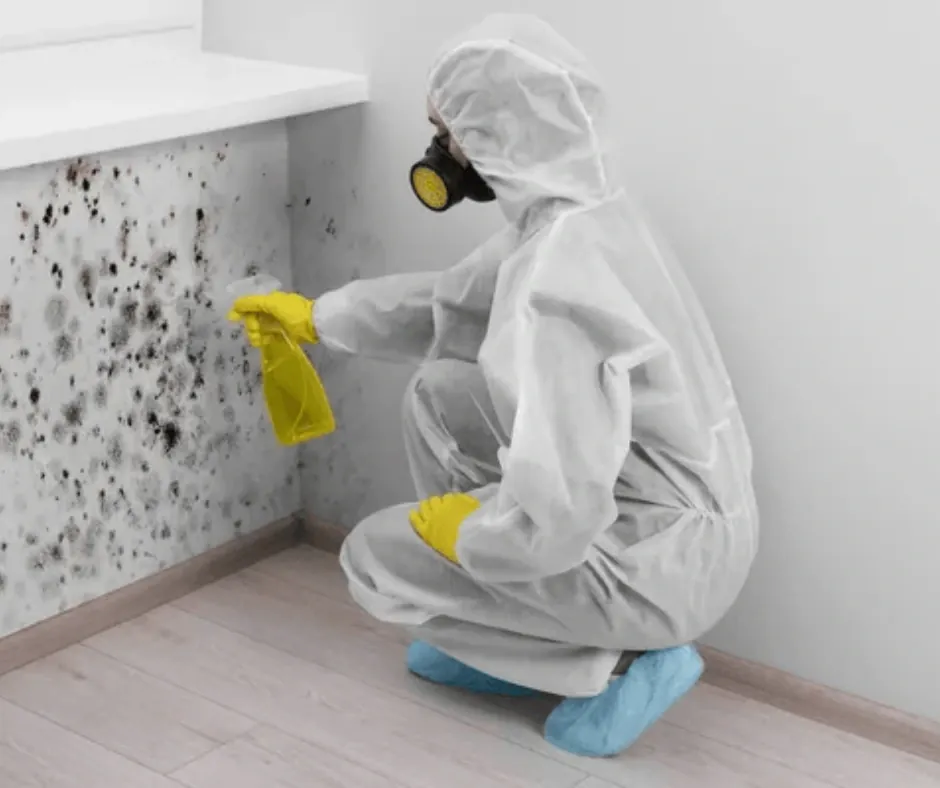
Containment is a sealed barrier around the work area. A negative air machine holds the pressure inside that barrier below the pressure of the rooms around it, so air moves into the containment rather than out of it, and what the machine pulls through is filtered through HEPA before it is exhausted.
Not every job needs the full setup. Settled dust in one corner, condition 2 in the S520 language, is usually HEPA vacuumed and damp wiped without a barrier. Growth inside a wall cavity is condition 3, and that is where containment earns its cost.
The reason for the barrier is that removal disturbs what has been sitting still. Cutting drywall out of a wet cavity puts far more into the air than the growth was putting there on its own, and S520 exists in large part to keep that from being carried through the rest of the building.
What comes out and what is cleaned
Porous materials that are colonized come out. Drywall, insulation, carpet pad, ceiling tile and particle board hold growth inside their structure rather than on their surface, and there is no reliable way to clean the inside of them in place.
Non porous and semi porous materials usually stay. Framing, concrete, tile, metal and finished wood are HEPA vacuumed and damp wiped, and an EPA registered antimicrobial goes on where the scope calls for it.
Where the water that caused the growth was contaminated, the rule is stricter. The S500 standard treats sewage and ground water as category three, and porous materials exposed to category three water are removed rather than cleaned, whether or not growth is visible yet.
The patch under about ten square feet
The EPA guidance is that a moldy area of less than about ten square feet, roughly a three foot by three foot patch, can in most cases be handled by the homeowner. That is the answer to the question most people are really asking when they call about a corner of a bathroom ceiling.
Two EPA points go with it. Fix the water first, because the growth returns without that. And a biocide such as chlorine bleach is not recommended as a routine practice during mold cleanup, which is worth knowing before a weekend is spent on it.
Call instead when the area is larger than that patch, when the growth is in or near the heating and cooling system, when the water was sewage or flood water, or when the same spot has come back after being cleaned once. If someone in the home is being treated for a respiratory condition, ask their doctor before anything is disturbed.
Drying, because a remediation ends dry
Removal without drying is half a job. Air movers and dehumidifiers are placed once the material is out, and moisture is read at set points each day until the material is back to a dry standard.
Those daily readings are kept. The S500 standard expects the drying process to be documented with readings recorded at each monitoring point on each day the project is active, and a photograph that catches the meter reading and the affected material in the same frame is what lets an adjuster check the figure without taking a written log on trust.
It protects the customer as much as the carrier. A space closed up while a cavity is still wet is a repeat job, and the readings are the only evidence either way.
The musty smell, and why nothing is fogged over it
Nothing is ozoned in an occupied home. A musty smell is the source telling you it is still there, and covering it with a fragrance or an ozone treatment removes the warning and leaves the problem.
The smell is traced back to its moisture source the same way the growth is. Where air and soft goods need treating once the source is out, hydroxyl and HEPA filtration are used and textiles are deodorized rather than perfumed.
If a smell survives a completed job, something is still wet or something was missed. The moisture readings and the containment notes are where that gets settled, which is another reason both are written down.
Post remediation verification, in writing
The job closes with a written post remediation verification: a statement that the area was cleaned, dried and checked, a document the customer keeps.
Where a sale, a landlord, a management company or a carrier needs a third party result, ask for an independent laboratory clearance on top of the verification. The request is normal on a sale, and nobody here reads it as a lack of trust.
Keep the document. It is what a buyer's inspector, a future tenant or an adjuster asks for, and it is far easier to hand over than to reconstruct two years later.
What New Jersey licenses, and what it does not
New Jersey issues no state license for mold remediation, so no company in this state can describe itself as state licensed for mold, and a company that does is worth asking what license it means.
What can be checked is certification. The IICRC certifies technicians under named designations, among them Water Damage Restoration Technician, Applied Structural Drying and Applied Microbial Remediation Technician, and it lists Certified Firms in a public directory. This business is IICRC certified, licensed and insured, and family owned since 2010.
Home improvement work in New Jersey also carries a registration obligation, a thirteen digit number beginning 13VH that has to appear in advertising. Ask which certifications the technician on your job holds, and ask any company you are comparing for its registration number.
Mold after a water loss
The EPA window is 24 to 48 hours: dry water damaged areas and items within that time to prevent mold growth. Inside the window, with the material dried through and not only dry to the touch, growth is unlikely. Past it, assume growth until a meter says otherwise.
This is why the water damage side of this business and the mold side are the same phone call. A loss dried properly in the first two days rarely becomes a mold job, and a loss left to dry by itself behind a closed door usually does.
Where a customer calls weeks after a leak, the sequence runs in the same order, with the inspection carrying more weight because the water is no longer obvious and the growth has had time to move away from it.
The heating and cooling system, and the ducts it feeds
A system that ran while growth was active moves that room's air into every room it serves. Where the inspection finds affected material in or near the return, the duct work is scheduled with the remediation rather than left for later.
Not every mold job needs the ducts cleaned. It is recommended when the system carried the affected air or when the growth is on the coil or in the return, and the inspection is what says which.
What the estimate covers, and what moves the price
There is a written estimate before any work begins and no hidden fees. What moves the number is the area, whether material has to come out, whether the space needs containment and negative air, how many days it takes to dry, and whether the heating and cooling system is part of it.
There is no price list for mold work, because the scope is set by what the inspection finds behind the wall and not by the square footage of the room. The estimate is the number, and it is written before the first cut.
Insurance is handled the way it is handled on a water loss. The damage is documented, so you have a complete file to give your insurer. This business does not file, adjust or negotiate a claim, and a company that offers to do that on your behalf is offering regulated work.