
For offices in Bloomfield, New Jersey, indoor air quality is not just a comfort issue—it is a business continuity concern. Mold and hidden moisture can trigger employee discomfort, damage finishes and technology, and disrupt operations with unplanned closures. The good news is that a disciplined, documentation-driven approach to commercial mold mitigation can restore healthy conditions while minimizing downtime. This guide explains how strong planning, engineering controls, and clear communication help office managers and property owners navigate the process. If you are evaluating options today, explore established mold mitigation services known for coordinated scheduling, predictable results, and thorough reporting.
Why offices in Bloomfield are at risk
Office buildings concentrate people, electronics, paper files, and soft finishes in climate-controlled spaces that run year-round. In Bloomfield’s four-season climate, frequent humidity swings can expose weaknesses in building envelopes, window assemblies, and rooftop equipment. Condensate lines from air handlers can clog, causing overflow. Fresh air dampers may stick, altering pressure relationships that pull damp air through wall cavities. Older tenant improvements can conceal past water damage, and ceiling tiles readily absorb moisture and spores.
Commercial spaces also share mechanical systems across multiple suites. A leak above one unit can migrate along structural bays to another. Unbalanced ventilation can create pockets of stagnant air where humidity rises and mold thrives. When staff report musty odors or discomfort, a rapid and organized response limits disruption and demonstrates a strong duty of care to employees and visitors.
Key components of a commercial assessment
A quality assessment addresses building science, operations, and occupancy. Inspectors review roofing details, mechanical rooms, plenum spaces, and tenant build-outs. They document visible staining, past repairs, and current humidity and temperature conditions. Moisture meters and thermal imaging help locate wet ceiling tiles, soffits, or columns. Where necessary, small exploratory openings may confirm conditions in concealed spaces.
Equally important is understanding how the space is used. Conference rooms, print areas, server rooms, kitchens, and wellness rooms have distinct moisture and ventilation profiles. The assessor develops a strategy to isolate zones, protect sensitive equipment, and sequence work to minimize interference with daily functions. They also plan communications, so occupants know what to expect and why steps are necessary.
Containment and engineering controls
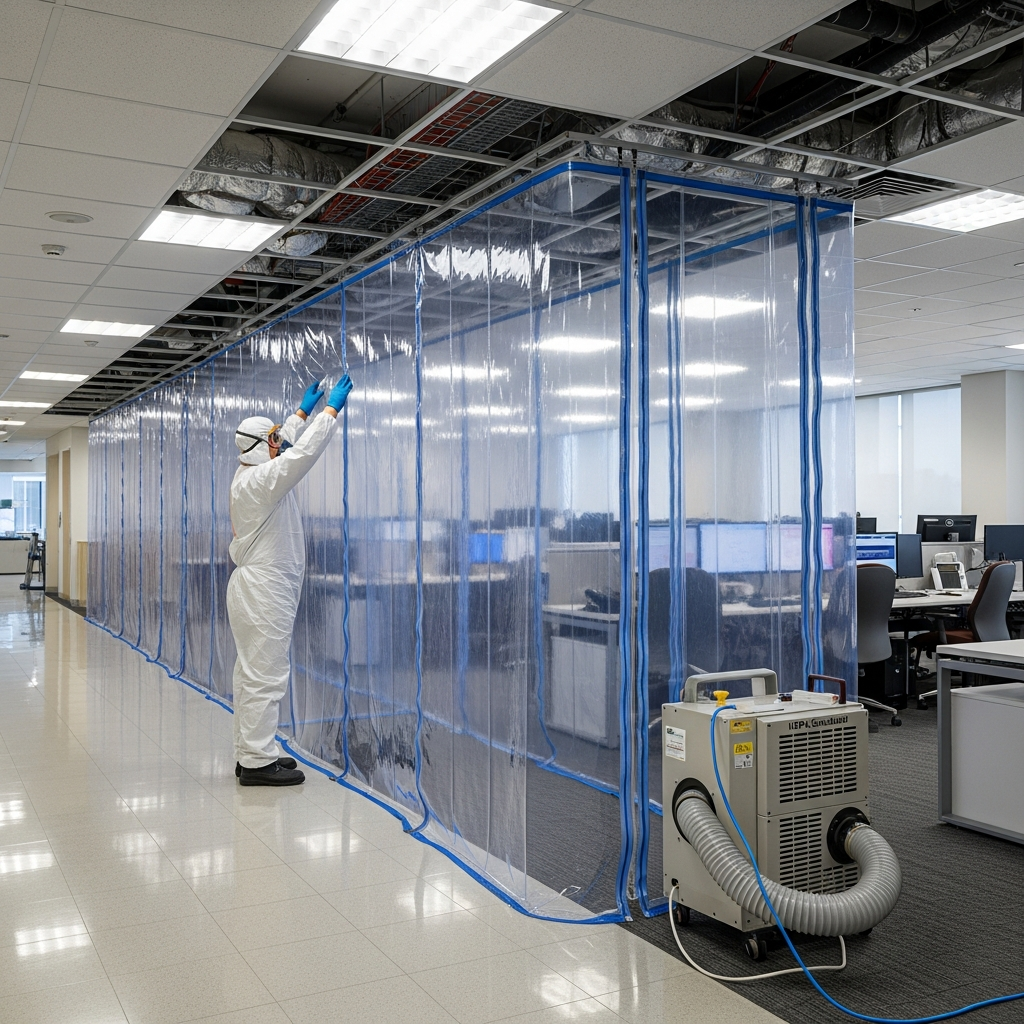
Containment in offices must be neat, secure, and well-labeled to keep corridors passable and emergency egress unobstructed. Negative air with HEPA filtration runs continuously during demolition and cleaning. Supply and return vents inside the work zone are sealed or temporarily adjusted in coordination with building engineers. Where ceilings are open plenum, extra attention is paid to sealing the containment envelope so spores and dust do not travel through shared pathways.
Noise, vibration, and odor control are addressed in the plan. Teams can schedule demolition during off-hours and use sound-dampening measures where feasible. They select cleaning solutions appropriate for occupied buildings and manage equipment placement to maintain accessibility. Proper waste handling—bagging at the source, sealing, and immediate removal—keeps common areas clean and professional.
Protecting technology and sensitive spaces
Server rooms, media suites, and conference centers require extra protection. Contractors coordinate with IT staff to shield racks and cabling, maintain temperature and humidity setpoints, and manage airflow changes introduced by containment. Paper archives and soft finishes are assessed for cleaning or removal to prevent ongoing particle shedding after mitigation.
Furniture systems and modular walls can hide pathways from ceiling to floor. An experienced team maps cable routes and anchors containment to avoid interfering with power and data. They communicate early about move-outs, move-backs, and staging for minimal operational disruption.
Process overview from start to finish
First, address the moisture source—repair condensate lines, roof flashing, or plumbing. Next, isolate the area with professional containment and establish negative pressure. Remove wet, porous finishes like ceiling tiles, saturated drywall, or carpet pad. Clean remaining substrates with HEPA vacuuming and damp wiping, then dry to target moisture levels using dehumidification and controlled airflow. Finally, document the work thoroughly and, where appropriate, coordinate third-party verification before demobilizing.
Mid-project updates keep stakeholders aligned. Project managers should issue daily summaries detailing containment status, materials removed, moisture readings, and upcoming work. Photographs and floor plans help executives, property managers, and tenants visualize progress and plan staffing or temporary relocations as needed. As you compare providers, examine how specialists in professional mold mitigation services present their reporting and coordination practices to support your business schedule.
Communication with employees and tenants
Successful projects treat communication as a core deliverable. Before work begins, provide a concise memo explaining what is happening, where containment will be located, anticipated hours, and how air quality will be protected. During work, maintain a predictable cadence of updates. Afterward, share summary documentation, including photos and final moisture readings, to demonstrate that healthy conditions are restored.
Clear messaging reduces anxiety and encourages cooperation. It also underscores the organization’s commitment to well-being and productivity. Employees appreciate transparency about timelines, noise, and temporary access restrictions, while tenants value coordination and respect for common areas.
Regulatory and documentation considerations
While mold regulations vary, commercial property owners and managers benefit from strong internal standards that mirror recognized best practices. Keep a record of the assessment, moisture findings, source repairs, containment plans, daily logs, photos, and verification steps. This file supports risk management, informs future maintenance, and can be critical evidence if real estate transactions or lease disputes arise.
In multi-tenant buildings, standard operating procedures for water intrusion events speed response and reduce downstream impacts. Post-event reviews identify opportunities to improve detection, communication, and prevention. Investing in staff training—such as recognizing early signs of moisture—pays dividends by catching small issues before they spread.
Long-term prevention in office environments
Prevention focuses on envelope integrity, mechanical balance, and vigilant maintenance. Inspect roof drains, flashing, and penetrations regularly. Confirm that outside air dampers operate properly and that economizer cycles are not causing chronic condensation. Calibrate thermostats and verify programming so temperatures and humidity remain stable even in lightly used zones. Add floor and condensate sensors in leak-prone areas to provide early warning.
Educate occupants on prompt reporting of damp ceiling tiles, musty odors, or condensate drips. Encourage housekeeping practices that reduce dust accumulation, which can serve as a nutrient layer. Work with building engineers to confirm that filter changes and coil cleanings stay on schedule, supporting healthy airflow and efficient dehumidification.
Frequently Asked Questions
Q: Can mitigation occur after hours to limit disruption? A: Yes. Many commercial projects schedule demolition and high-noise activities during evenings or weekends, with containment and air filtration operating continuously to keep adjacent spaces clean.
Q: Do we need third-party clearance? A: Independent verification is often beneficial for documentation and peace of mind, especially in multi-tenant or high-sensitivity spaces. Discuss criteria with your mitigation provider and a qualified assessor.
Q: How do you protect electronics and files? A: Teams coordinate with IT and facilities to shield equipment, maintain setpoints, and plan sequencing so sensitive spaces remain stable. Paper and soft finishes are evaluated for cleaning or disposal to prevent residual particle shedding.
Q: What if hidden moisture is discovered mid-project? A: The protocol should include decision points for expanding containment and adjusting schedules. Transparent updates and revised floor plans keep stakeholders informed and operations predictable.
Q: Can mold return in offices? A: Yes, if moisture recurs. Ongoing maintenance of HVAC, roofing, and plumbing combined with employee reporting is the best defense against recurrence.
Q: Are shared plenums a special concern? A: They can be. Extra attention to containment sealing and airflow control is required so spores and dust do not migrate through open plenum paths into adjacent suites.
Keep your workplace healthy and productive
A well-run mitigation project protects your brand, your people, and your property. By pairing building science with precise documentation and thoughtful scheduling, you can restore healthy conditions with minimal disruption. When you are ready to act, partner with a provider that communicates clearly, coordinates with building engineers, and delivers verifiable results. For organized, office-friendly support in Bloomfield, reach out to trusted experts in mold mitigation services and move your team back into a cleaner, healthier workspace with confidence.