
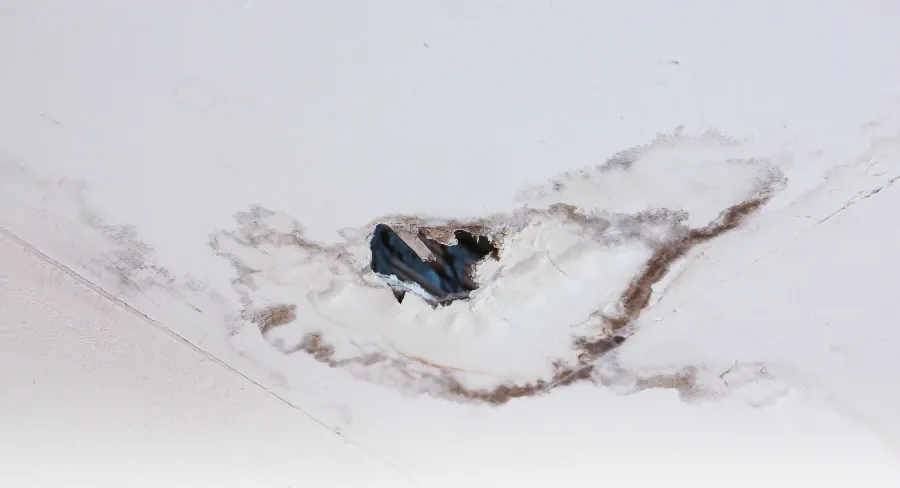
Burst and frozen supply lines
A pipe bursts because water expanded in it or because the pipe failed at a joint, a fitting or a corroded section. The freeze case is the North Jersey winter case, and the pipes that freeze are the ones in unheated space: an exterior wall cavity, a crawl space, an unheated garage, an attic run and any line feeding an outside faucet that was not drained.
The damage from a frozen pipe usually happens on the thaw rather than during the freeze, which is why a house found cold and quiet can flood an hour after the heat comes back on. If pipes are frozen and have not yet burst, shutting the main before thawing them is the move that keeps a repair from becoming a restoration job.
Water from a supply line is category 1 at the moment it leaves the pipe. It stays category 1 for a short time and then it does not, because it picks up what it runs across and because a warm building degrades it. The assessment is made from the hours as much as from the source, which is the reason the first question on the call is when it started rather than what broke.
Water heaters, washing machines and dishwashers
Appliance failures split into two kinds and they are treated differently. A water heater or a supply hose that let go on the clean side is category 1 water, and it usually behaves like a burst pipe, with the extra problem that a water heater holds a full tank and releases all of it at once into whatever room it sits in.
A discharge failure is category 2. A washing machine drain hose that came out of the standpipe, a dishwasher that overflowed and a condensate pump that backed up are all gray water, which means what is in the water matters and the porous material it soaked usually comes out rather than being dried. That distinction is the difference between a pad that stays and a pad that goes.
The two most common preventable failures in this group are rubber washing machine supply hoses that were never replaced and a water heater past its service life sitting on a finished floor with no pan and no drain. Both are worth checking, and both are on the prevention checklist rather than being anything a restoration company can help with after the fact.
Air conditioning condensate leaks
An air handler pulls moisture out of the air and that water has to go somewhere. The condensate drain line carries it away, and when the line blocks with biological growth, the pan rusts through or the pump fails, the water backs up and comes out of the bottom of the unit. Because it is a slow leak from a machine that runs unattended, it is usually found late.
Two things make condensate leaks worse than their volume suggests. The water is not clean: it has been sitting in a pan and a line where growth is normal, which puts it at category 2. And the leak is often in an attic or a closet above a finished ceiling, so the first sign is a stain on the ceiling below and by then the insulation in the ceiling has been wet for days.
The work is the same as any category 2 loss reached late: the affected ceiling and insulation come out rather than being dried, the cavity is cleaned, and the framing is dried to a measured standard. The blockage itself is an HVAC repair, and the annual habit that prevents most of these is having the drain line cleared before the cooling season, not after the ceiling stains.
What is covered and what reads as maintenance
The line most carriers draw is between sudden and accidental damage and long term seepage. A pipe that burst last night is sudden. A fitting that has wept behind a wall for eight months and rotted the framing is usually treated as maintenance and excluded, whatever the water eventually did.
That has a practical consequence at the moment of discovery. Photograph the failure point itself before it is repaired, because the plumber's repair removes the evidence of what failed and how. Photograph the wet material before anything is torn out. Keep the piece of pipe or the failed hose if a plumber replaces it.
The file is written the same way regardless of how the carrier eventually decides: photographs from before anything moved, a category and class assignment, a moisture map, a daily reading log and an inventory of what was removed and why, so you have a complete file to give your insurer. We do not file, adjust or negotiate the claim.