In place drying, and where it stops working
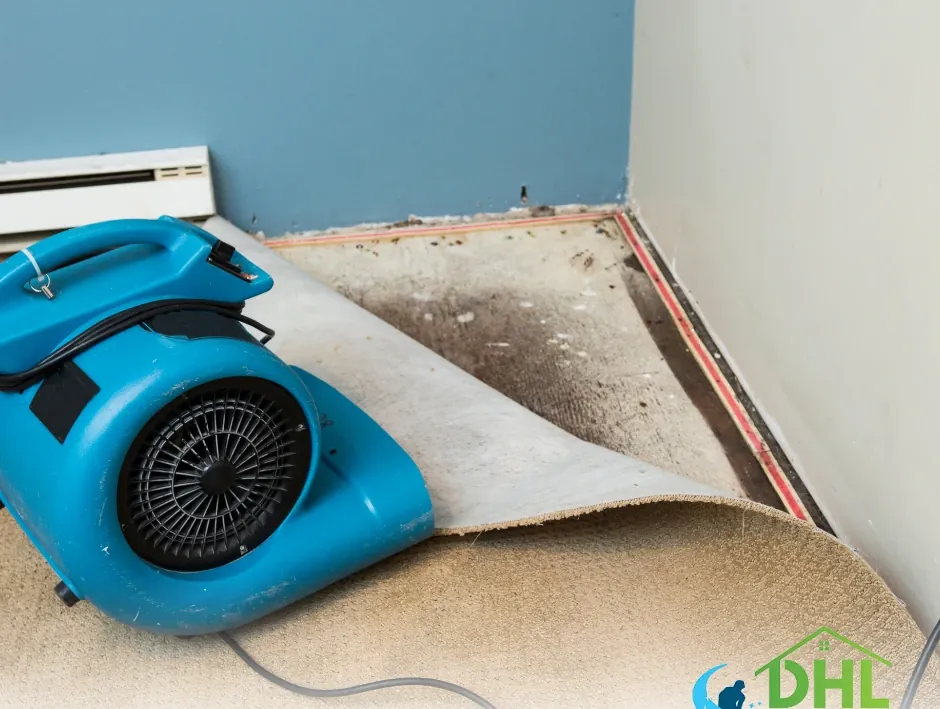
In place drying means the carpet stays down and the water is taken out through it. The carpet is extracted with a weighted tool that presses the carpet and pad against the subfloor, then floated at one edge so air can be forced into the space between the carpet and the pad, with dehumidification holding the room dry enough to accept what comes off.
It works, and it has conditions. The water has to be category 1 or a category 2 loss caught in the first hours. The pad has to release water under extraction instead of staying saturated. The subfloor has to be reachable. And the readings have to keep moving, because the point of in place drying is a dry floor rather than a floor that was not lifted.
Where any of those fail, the carpet comes up. A pad that will not release is a pad that stays wet under a carpet that reads dry on top, which is exactly the condition a musty smell comes from weeks after the room looks dry.
What happens to the carpet itself
Carpet face fiber is resilient. Nylon, polyester and olefin all survive being soaked, and wool survives it too although wool holds far more water and takes longer to give it up. The face fiber is rarely the problem.
The backing is the problem. Most residential carpet is made of a face fabric bonded to a secondary backing with latex adhesive, and prolonged saturation breaks that bond. The result is delamination: the backing separates, the carpet loses its dimensional stability and it ripples permanently when it is re stretched. Delamination is checked for before a carpet is committed to drying, because a delaminated carpet dried for four days is four days spent on a carpet that has to be replaced anyway.
Seams are the other weak point. A soaked seam tape lets go, and a carpet that has been lifted and floated needs its seams checked and re done before it is re stretched. Where the carpet survives, it is cleaned after drying with the method matched to the fiber, and re stretched properly rather than pushed back into the grippers.
What is under the carpet matters as much
A wooden subfloor takes water into the top layers of plywood or board and holds it. It usually dries, and it takes longer than the carpet above it, which is the reason a floor is not closed up on the day the carpet reads dry. A particle board underlayment is different: it swells, loses strength and does not recover, and it is removed rather than dried.
A concrete slab is class 4 material. It absorbs water into its surface layer and gives it back slowly for days, and a carpet laid back over a slab that is still releasing will read wet again within a week. The slab is read with the appropriate meter and the pad goes back only when the slab is at its standard.
Tack strip is checked and replaced where it has swollen or rusted, and the perimeter is one of the fixed monitoring points, because the edges of a room dry last and are where the readings usually flatten first.
Area rugs are a separate decision
An area rug on a wet floor is lifted immediately and it does not stay in the room to dry. A wet wool or silk rug lying flat on a hardwood floor bleeds dye into the floor within hours, and the floor damage is often worse than the rug damage. Lifting it is the single most useful thing a homeowner can do to an area rug in a water loss.
Rugs are dried off site rather than in place, because they need to be dried flat with air on both faces and controlled humidity, and because a wool rug dried too fast or too slowly is a rug with a permanent problem. The rug cleaning service covers that work, including flood damaged rugs where the water was contaminated.
Where the rug was in category 3 water, the same rule applies to it as to any other porous item. A rug with sentimental or monetary value gets an assessment rather than an automatic answer, and you are told plainly what the risk is before anything is attempted.